The phrase "Jain-friendly" has become so common on Toronto restaurant menus that it has almost lost meaning. Ask a server what it means at most establishments and you will hear some version of: "We can make it without onion and garlic."
That is not truly Jain. That is a modification. And for anyone who actually keeps Jain, the difference is not a matter of preference. It is a matter of faith. This article explains what genuine Jain and Satvik preparation requires, why most restaurants fall short of that standard, and what Sangeetha actually does about it.
What Jain Dietary Law Actually Requires
Jain ahimsa, the principle of non-violence, extends to food in very specific ways. The Jain diet avoids not just meat and fish, but also any ingredient whose harvest involves harming or killing living organisms unnecessarily. This includes:
Root vegetables are forbidden.
Onion, garlic, potato, carrot, beetroot, and other root vegetables are excluded from strict Jain eating because harvesting them destroys the entire plant and the micro-organisms living in the root zone. This is not a preference. It is a core requirement.
Cross-contamination is as serious as the ingredient itself.
A dish prepared in a pan that previously cooked onion is not Jain-safe, even if onion is not in the dish. Shared cooking oil, shared spatulas, shared countertops: each represents a failure of the standard. For a devout Jain, eating food that has been prepared in this way is the same as eating the forbidden ingredient itself.
The preparation space matters.
In a traditional Jain home, food is often prepared in a designated area with designated utensils that never touch non-Jain ingredients. What is acceptable in a home kitchen requires equivalent rigour in a restaurant kitchen if the restaurant is to be genuinely trusted.
What Satvik Means and How It Differs
Satvik comes from the Sanskrit word sattva, meaning purity and clarity of mind. Satvik food is part of Ayurvedic philosophy and refers to food that promotes lightness, mental clarity, and spiritual wellbeing. It excludes onion and garlic, classified as Rajasic (stimulating) and Tamasic (dulling), along with anything fermented, heavily processed, or overcooked.
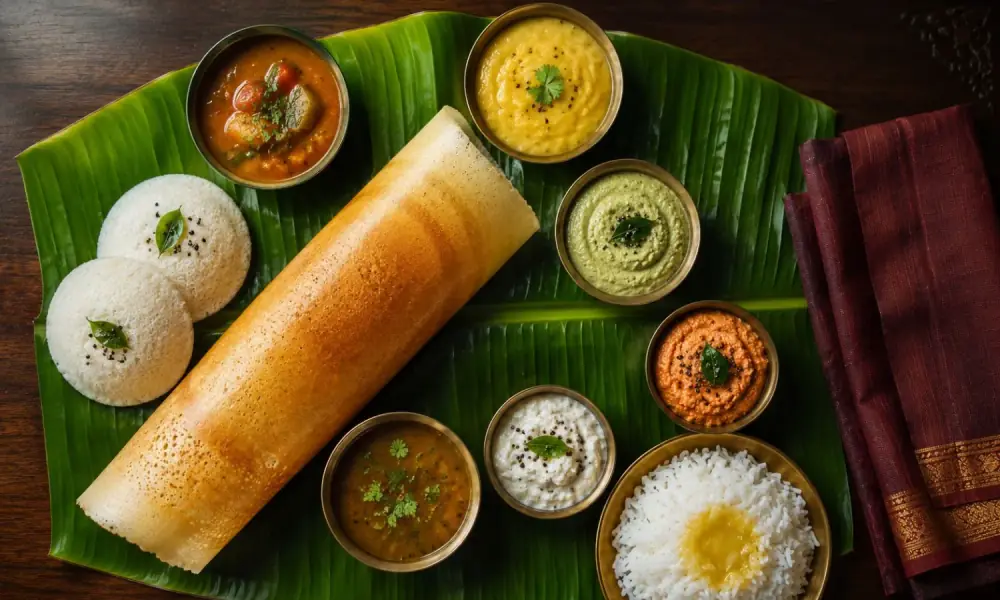
South Indian food has a particularly strong natural alignment with Satvik principles. Many traditional South Indian dishes such as idli, plain dosa, pongal, and coconut chutney contain no onion or garlic by default and are made from simple, clean ingredients. Our fermented batter is actually an interesting exception to the no-fermentation rule: in South Indian food tradition, fermentation of rice and lentils is considered beneficial and the resulting food is light and digestible rather than heavy or stimulating.
The Problem with "We Can Remove the Onion"
This is where most restaurants fail the Jain community, even with good intentions. A kitchen that cooks regularly with onion, garlic, and non-vegetarian items has those flavours, oils, and residues in its pans, its serving spoons, its work surfaces, and its cooking oil. Removing those ingredients from a specific dish does not undo any of that.
Imagine asking a baker who uses butter in everything to make you a vegan cake by "just leaving out the butter this time." The equipment is already cross-contaminated. The environment is not built for what you need. The result may technically omit the ingredient but it is not the standard that was promised.
For the Jain community in Toronto, this has been the lived experience at most restaurants. The food is modified. But it is not made right.
What We Believe Actually Matters
Recipe integrity, not modification.
A Jain dish should be designed without onion, garlic, or root vegetables from the very first ingredient list, not adapted afterward by leaving something out. That distinction changes the flavour, the technique, and the intention behind the dish.
Consistency, every single day.
A dish that's "available if you ask" is not the same as a dish that's simply on the menu. If you keep Jain, you should not have to call ahead, explain your needs, or hope the kitchen has time to accommodate you that day.
How Sangeetha's Jain & Satvik Menu Works
At Sangeetha, our Jain & Satvik menu is a dedicated part of our operations, not an afterthought. Here is what that means in practice:
Every dish on our Jain & Satvik menu is designed without onion, garlic, or root vegetables from the recipe itself, not adapted from an existing dish by leaving something out. The same fresh, from-scratch South Indian cooking that goes into the rest of our menu goes into every Jain and Satvik dish.
Our Jain & Satvik menu is available every day, not just on weekends or by special request. If you keep Jain, you should not have to call ahead and negotiate. You should be able to walk in, sit down, and eat with complete confidence.
We serve the Jain community from across the GTA: Mississauga, Brampton, North York, Markham. They have told us that Sangeetha is where they bring guests when they need to be certain about the food. That trust is built one visit at a time, and we do not take it lightly.