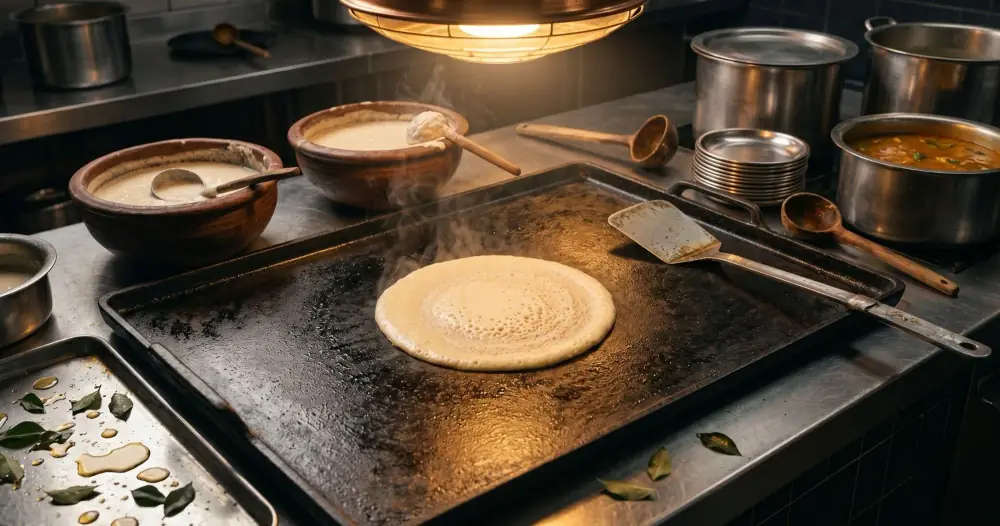
Every dosa we serve started its life the day before you ate it. The recipe itself is old and short: rice, urad dal, a little fenugreek, water, and salt. Nothing in that list explains why one dosa comes off the pan golden and lacy while another turns out pale and flat. The difference is time.
What Fermentation Actually Does
Once the rice and dal are ground and mixed, the batter begins to ferment on its own. Wild yeasts and lactic acid bacteria, the same natural cultures behind sourdough bread, get to work on the starches. They do three things at once: they fill the batter with tiny air bubbles, they build the gentle tang that gives a dosa its character, and they partially break down the grains, which is why a properly fermented dosa sits so lightly on the stomach.
None of that can be rushed. Quick batters made with soda or yeast shortcuts imitate the bubbles, but they cannot imitate the flavour or the digestibility. Fermentation is the one ingredient you cannot buy.
Why 18 Hours
Batter keeps changing the whole time it ferments. Give it too little time and the dosa is dense and pale, with no depth to the taste. Leave it too long and the batter turns sharply sour and loses its structure. Somewhere between those two points is a window where the flavour is round, the batter is full of life, and the first dosa of the day behaves exactly like the last.
In our kitchen, at the temperature we hold the batter, that window is 18 hours. Not 16, and not 20. It is the number our cooks trust, checked every single morning before the first order goes out.
What It Means on the Plate
The same batter carries a double life. Spread thin on a hot pan it becomes a crisp dosa, from the classic ghee roast to a paper dosa. Steamed instead, it becomes soft idli. If you have ever wondered why the two taste like cousins, this is why: one batter, one fermentation, two completely different plates.
There is one more thing worth knowing about it. The batter contains nothing but rice, dal, fenugreek, water, and salt. No onion, no garlic, nothing hidden. That is why our dosas and idlis sit so comfortably on our Jain & Satvik menu, and why we wrote about how naturally South Indian food fits Jain diets.